

Easter Bread always sounds like a sweet, cozy idea until you realize you still have to pick a recipe, shop for ingredients, and somehow fit baking into a busy weekend. If you have ever stared at your calendar thinking, I want something special for Easter morning but I do not want a complicated project, you are in the right place. This is the recipe I make when I want my kitchen to smell like vanilla and warm bread, and I want everyone to wander in asking, is it ready yet? It is soft, lightly sweet, and pretty enough to put right in the center of the table. Most importantly, it feels like a little tradition you can actually pull off.

A Little More History
I grew up seeing sweet holiday breads show up like magic around Easter. Someone always had one on the counter, usually covered with a clean towel, and you just knew it was meant to be sliced and shared. Italian Easter bread is one of those recipes that looks fancy, but the heart of it is simple: a slightly sweet dough, shaped in a way that feels celebratory.
Depending on the family, you might see it baked as a braided ring, a long braid, or little individual nests. Some versions are topped with sprinkles, some have colored eggs tucked into the braid, and some are kept plain and glossy. The point is not perfection. The point is that you made it, it is warm, and it brings people together.
In my house, this bread is tied to the small stuff I love most about Easter morning: coffee brewing, pajamas still on, and somebody sneaking into the kitchen to pull off a tiny piece before breakfast. That is the feeling I hope you get when you bake it too.

Key Ingredients & Notes
Let us talk about what makes this bread taste like Easter to me. Nothing is weird or hard to find, and I am going to give you the little notes that save you headaches later.
What you will need
- All purpose flour: dependable and easy. You can use bread flour if you have it, but you do not need it.
- Active dry yeast: check the date. Old yeast is the fastest way to end up with a sad loaf.
- Milk: warmed slightly, not hot. Think warm bath water. If it is too hot, it can hurt the yeast.
- Sugar: gives sweetness and helps the dough feel tender.
- Eggs: for richness and that soft, special holiday crumb.
- Butter: melted and cooled a bit, so it mixes in smoothly.
- Vanilla and citrus zest: I love orange zest here. Lemon is great too. This is where the Easter vibe really kicks in.
- Salt: do not skip it. It keeps the flavor from tasting flat.
- Sprinkles (optional): totally fun. Use what you like.
- Egg wash: one egg beaten with a splash of milk or water for shine.
Quick practical notes from my own kitchen:
If your house is chilly, dough can take longer to rise. That is normal. I usually let it rise near the oven while it preheats, or I set it near a sunny window. Also, measure your flour with a light hand. If you scoop straight from the bag and pack it in, the dough can turn stiff. You want it soft and a little tacky at first, not dry.
“I made this for Easter brunch and my kids kept sneaking slices all day. It stayed soft, and the orange zest made it smell amazing. This is going in our family recipe box.”
;
That little mix of vanilla and citrus is the reason I keep coming back to this Easter Bread recipe year after year. It just tastes like a holiday without being heavy or overly sweet.
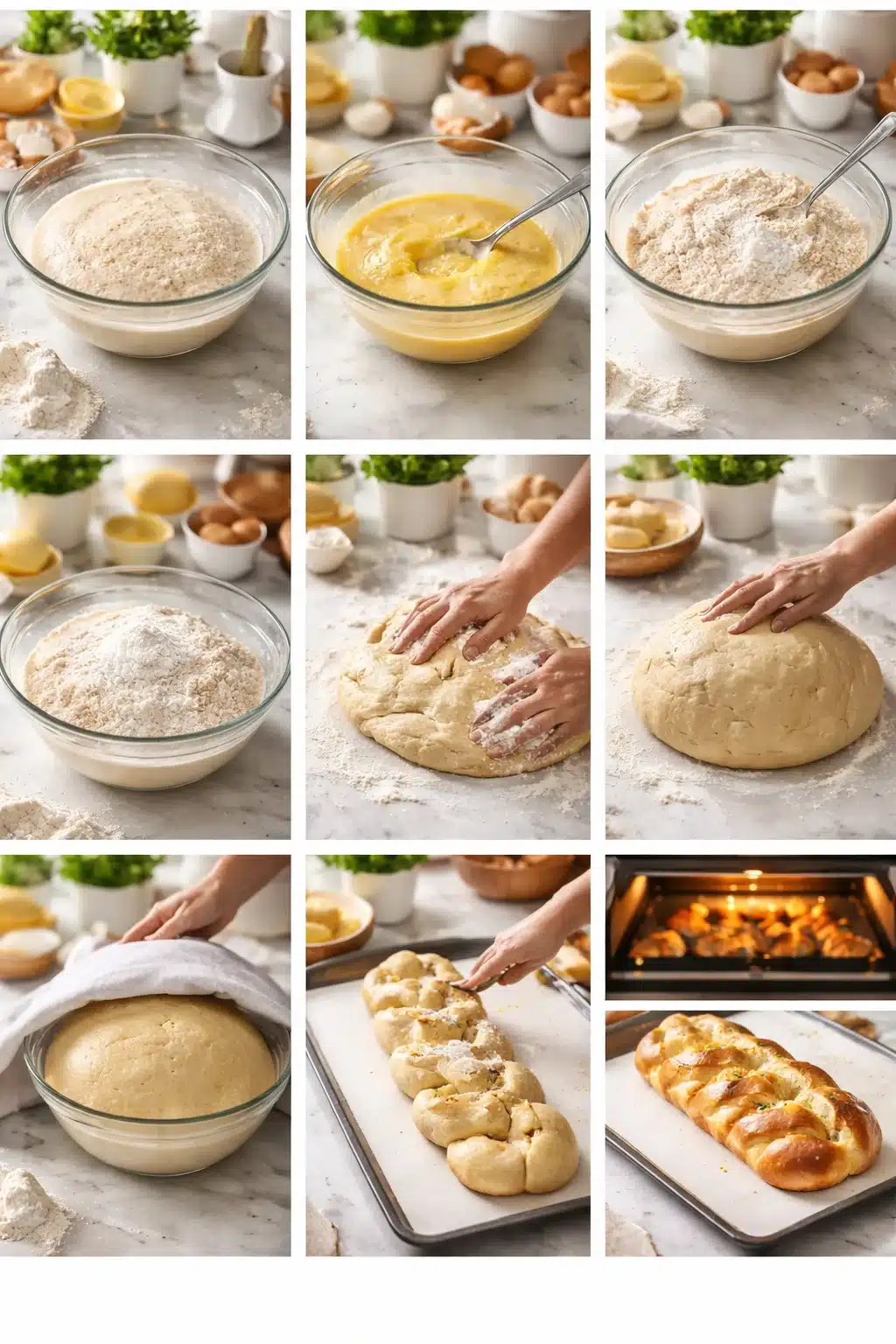
How to Make Italian Easter Bread
This is the part where I talk to you like I would if you were standing in my kitchen. We are not rushing. Put on music, clear a little counter space, and know that the dough does most of the work while you wait.
Step by step directions
1) Wake up the yeast. Warm the milk until it is just warm to the touch. Pour it into a big bowl, stir in a spoonful of sugar, then sprinkle the yeast on top. Let it sit for 5 to 10 minutes until it looks foamy. If nothing happens, your yeast might be old or the milk might have been too hot or too cold.
2) Mix the wet ingredients. To the yeast bowl, add the eggs, the rest of the sugar, melted butter, vanilla, zest, and salt. Stir it up until it looks smooth and glossy.
3) Add flour and make a soft dough. Add flour a bit at a time, stirring until you cannot easily stir anymore. Then use your hands to bring it together. If it is super sticky, sprinkle in a little more flour. If it feels dry and tough, add a tiny splash of milk. You are aiming for soft and stretchy.
4) Knead a little. On a lightly floured counter, knead for about 6 to 8 minutes. You will feel it change. It goes from shaggy to smooth, and it starts to spring back when you press it. That is what you want.
5) First rise. Place the dough in a lightly greased bowl, cover, and let it rise until doubled. This can take about 60 to 90 minutes depending on your kitchen.
6) Shape it. Punch the dough down gently, then split it into 3 equal pieces. Roll each piece into a rope. Braid the ropes and pinch the ends. You can shape it into a circle for a wreath look or keep it as a long braid. If you want to add colored eggs, you can nestle them into the braid gently. Use raw dyed eggs if you want them to bake in place, or add already dyed hard boiled eggs after baking as decoration.
7) Second rise. Move the braid to a parchment lined baking sheet, cover lightly, and let it puff up again for about 30 to 45 minutes.
8) Egg wash and sprinkles. Brush with egg wash, then add sprinkles if you are using them. This is the fun part, especially if kids are helping.
9) Bake. Bake at 350 F until golden brown. In most ovens it takes 22 to 30 minutes, depending on the thickness of your braid. If it browns too fast, loosely tent it with foil for the last few minutes.
10) Cool before slicing. I know it is hard, but give it at least 20 minutes. Warm bread slices better when it has a moment to set.
When it comes out of the oven, it smells sweet and bright, and the top is shiny and golden. That is the moment where Easter Bread feels like more than just baking. It feels like you made something that sets the tone for the whole day.
Storage and Freezing Instructions
This bread is at its best the day it is baked, but it keeps surprisingly well if you store it the right way. The goal is to keep it soft without trapping too much moisture.
To store at room temperature: Let the bread cool completely. Wrap it in plastic wrap or store it in an airtight container. It stays soft for about 2 to 3 days. If your kitchen is very warm, check it daily.
To refresh slices: Toast lightly, or warm in the microwave for 10 seconds. Add butter or a little jam and it tastes like a treat with coffee.
To freeze: Wrap the whole loaf or individual slices in plastic wrap, then put in a freezer bag. Freeze up to 2 months for best flavor. Thaw at room temp, still wrapped, so it does not dry out. If you want that fresh baked feel, warm the thawed bread in a 300 F oven for about 10 minutes.
One more thing I have learned the hard way: do not slice and leave it exposed on a cutting board unless you want it to dry out fast. Cover the cut side or wrap it back up.
More Easter Breads
If you love the idea of making something sweet and holiday themed, there are so many directions you can go. I like having options depending on the mood and the crowd.
Sweet rolls are great if you want easy portion sizes. You can do a simple vanilla glaze, or even a cream cheese glaze if you want it richer.
Hot cross buns have that classic spiced vibe. They are a little more like a soft bun than a braid, and they are perfect if you like cinnamon, nutmeg, or raisins.
Brioche style loaves are richer and buttery, and they make amazing French toast the next day.
But if you want one recipe that hits the sweet spot between easy, pretty, and crowd pleasing, I keep coming back to Easter Bread because it looks special without making you feel like you need a culinary degree. And once you make it once, you will see how flexible it is. Different zest, different sprinkles, a little drizzle of icing, you can make it your own.

Common Questions
Can I make the dough the night before?
Yes. After the first rise, shape the braid, cover it well, and refrigerate overnight. In the morning, let it sit at room temp until it looks puffy again, then bake.
My dough is sticky. Did I mess up?
Probably not. A slightly sticky dough bakes up soft. Add flour a spoonful at a time only if it is so sticky you cannot handle it at all.
Do I have to use citrus zest?
No, but I really recommend it. Orange zest makes it taste like a true Italian Easter bread. If you skip it, add a bit more vanilla for flavor.
Can I add raisins or chocolate chips?
Absolutely. Add about 1/2 to 3/4 cup after you have mixed most of the flour in, so they distribute evenly.
How do I know when it is done baking?
Look for a deep golden top and a loaf that feels light when you lift it slightly. If you tap the bottom gently, it should sound a bit hollow. If you have a thermometer, aim for about 190 F inside.
A Sweet Easter Morning Is Worth It
If you want something homemade that feels festive but still doable, this Easter Bread is it. You get a soft, lightly sweet loaf with that vanilla and citrus smell that makes the whole kitchen feel warm. Keep it simple, follow the rise times, and do not stress about the shape being perfect. Bake it once, and you will see why people make this year after year. I hope you try it and let it become part of your Easter morning too.
Print
Italian Easter Bread
- Prep Time: 30 minutes
- Cook Time: 30 minutes
- Total Time: 90 minutes
- Yield: 1 loaf 1x
- Category: Bread
- Method: Baking
- Cuisine: Italian
- Diet: Vegetarian
Description
A soft, lightly sweet bread infused with vanilla and citrus, perfect for Easter morning celebrations.
Ingredients
- 4 cups all-purpose flour (more for dusting)
- 1 packet active dry yeast
- 1 cup milk, warmed
- 1/2 cup sugar
- 2 large eggs
- 1/2 cup butter, melted
- 1 teaspoon vanilla extract
- 1 tablespoon orange zest
- 1 teaspoon salt
- Sprinkles (optional)
- 1 egg, beaten (for egg wash)
Instructions
- Wake up the yeast: Warm the milk until it is just warm to the touch. Pour it into a big bowl, stir in a spoonful of sugar, then sprinkle the yeast on top. Let it sit for 5 to 10 minutes until it looks foamy.
- Mix the wet ingredients: Add the eggs, the rest of the sugar, melted butter, vanilla, zest, and salt to the yeast bowl. Stir until smooth.
- Add flour and make a soft dough: Gradually add flour until you cannot stir anymore, then use your hands to bring it together, adjusting with flour or milk as needed.
- Knead the dough: On a floured counter, knead for about 6 to 8 minutes until smooth and elastic.
- First rise: Place the dough in a greased bowl, cover, and let it rise until doubled (about 60 to 90 minutes).
- Shape the dough: Punch it down, split it into 3 pieces, roll each into a rope, and braid or shape as desired.
- Second rise: Move to a lined baking sheet, cover lightly, and let it puff up again for about 30 to 45 minutes.
- Egg wash and sprinkles: Brush with egg wash and add sprinkles if desired.
- Bake: Preheat to 350°F and bake for 22 to 30 minutes until golden brown.
- Cool before slicing: Let it cool for at least 20 minutes before slicing.
Notes
Store at room temperature wrapped in plastic wrap for 2-3 days. To freeze, wrap well and store in a freezer bag for up to 2 months.
Nutrition
- Serving Size: 1 slice
- Calories: 250
- Sugar: 8g
- Sodium: 200mg
- Fat: 10g
- Saturated Fat: 5g
- Unsaturated Fat: 5g
- Trans Fat: 0g
- Carbohydrates: 35g
- Fiber: 1g
- Protein: 6g
- Cholesterol: 40mg
